
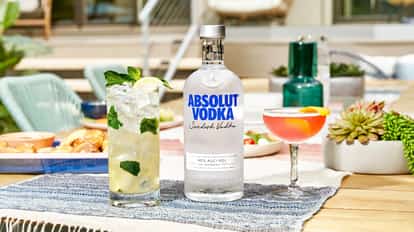
Understanding Vodka Alcohol Content
Vodka’s smooth flavor gives it a whole lot of potential, whether you’re looking at cocktails, mixers or straight drinks. As with all alcoholic drinks, understanding the alcohol content of vodka is important to help you drink responsibly.
When you hold a bottle of Absolut in your hands, you should be able to see a percentage number on the label. This is Alcohol by Volume (ABV), and it represents the amount of pure alcohol in the spirit. You may also see the term ‘proof’ used, which is another method of measuring the alcohol percentage. Proof is typically shown as twice the ABV.
If you want to manage your intake, drink responsibly, and make informed choices about alcohol in vodka, read on.
Decoding Vodka: Why Alcohol Content Matters
Absolut Vodka provides a smooth, clear taste, which makes it the perfect base for any vodka-based cocktail. However, as with any alcohol, it’s always sensible to understand how much you’re consuming. While the alcohol levels of Absolut can impact its flavor, there are several reasons why alcohol content matters.
We explore some key reasons below:
Responsible Consumption and Pacing
Knowing how much alcohol you’ve consumed is important for making smart decisions and, ultimately, drinking sensibly. If you’re drinking cocktails or mixing drinks, it can be difficult to keep track of how much you’ve had. If you’re adding ABV 40% vodka to your drinks, pacing your alcohol intake can prevent overconsumption.
Mastering Cocktail Creation
The level of alcohol in a drink might impact its flavor and how well it pairs with cocktail ingredients. Some cocktails call for stronger proof, whereas others could be overpowered by a high ABV %. For example, the 100 Negroni uses 100 proof vodka, whereas our Absolut Classic Cosmopolitan contains 20% ABV, and the Absolut Grapefruit Paloma 7%.
Making Informed Purchase Decisions
Much like making cocktails, different occasions or situations might call for different strengths. Being able to see and understand the difference between 20, 40 and 50% ABV allows you to make informed purchasing decisions. ABV can vary significantly not just across types of vodkas but also across brands so always be sure to check when making a purchase.
Navigating Legal and Social Considerations
Understanding alcohol content is important for responsible drinking. Excessive drinking can have a negative impact on your well-being and those around you, so you should always be considerate of the alcohol content in vodka.
Proof and ABV: The Language of Alcohol Content
Now that we’ve explored the importance of understanding the alcohol content in vodka, we can dive a little deeper into the subject.
What is “Proof”? A Historical Perspective
Proof, much like ABV, is the measurement of alcohol in any given spirit. The main difference between the two is the scale. Proof is measured as twice the ABV percentage. So, if a bottle of Absolut Citron is 40% ABV, its proof is 80. The term “proof” originates in 16th century England, where the government taxed spirits based on how strong they were.
They tested this by soaking gunpowder in a spirit before attempting to light it on fire. If the spirit-soaked gunpowder lit, the spirit was deemed strong enough to tax. However, this method wasn’t 100% reliable as the flammability of the spirit also depended on its temperature.
What is ABV? The Scientific Standard
ABV, or Alcohol by Volume, shows the percentage of pure alcohol in a drink. The higher the ABV percentage, the higher the amount of alcohol, specifically ethanol, in the beverage. For example, if you have a 25 fl. oz bottle (a ‘Fifth’) at 50% ABV, a half bottle would be pure ethanol, while the remaining half would be water and flavorings.
In the US, alcoholic drinks manufacturers are legally obliged to include the ABV on their product labels.
The Interplay Between Proof and ABV
ABV and proof both measure the proportion of alcohol in a liquor, but use different metrics, much like miles and kilometers. Here in the US, we often go by proof, but ABV is mandatory on all labels and is also the standard measurement around the world.
While ABV is the standard measurement, the calculations between ABV and proof are sometimes different, depending on the country you’re in. If you want to work out the ABV from the proof (or vice versa) in the States, ABV is half the proof.
In this way, 40% ABV would be 80 proof. But if you were in Paris, France, the proof would be the same as the ABV, so 40% ABV would be 40 proof.
The Standard: 80 Proof Vodka and its Significance
In the United States, vodka has to be 80 proof (40% ABV) or more to be sold in the United States because of regulatory standards.
This threshold means that when you buy vodka, whether in Nevada or New Hampshire, you know what to expect when it comes to the strength of your liquor.
The settling of vodka at 80 proof, or 40% ABV, has historical connections, while also meeting practical and consumer expectations. It allows us to produce a vodka that balances flavor with smoothness and versatility.
If you’re travelling on vacation, you might expect the typical 80 proof standard to change slightly from country to country.
Finding the Alcohol Content for Different Vodkas
If you’re ever curious about the alcohol content in different vodkas, you can check the following:
- The label – This should be your first port of call when it comes to checking the alcohol content of a drink. You should be able to clearly see the ABV percentage and the proof of the drink on the label. With most of our bottles, you can find the proof on the front as ALC/VOL, which is the same as ABV.
- Fine print – Not all bottles will display the proof as prominently, but in most cases it’s legally mandated to include it. This means you may have to look at the fine print on the back of the bottle. This may be near the bar code or tucked underneath any descriptive text.
- International varieties – If you own or have been gifted an international bottle, the placement of the proof or ABV might be in a different location than one you expect. However, with a quick check, it shouldn’t take you long to find the percentage.
Exploring Vodkas with Varying Alcohol Content: Beyond the Standard
You may have already noticed that the alcohol content of Absolut drinks varies from product to product. A lot of this is down to the versatility of vodka, and the way it can be adapted to almost any cocktail.
If you’re making cocktails, the proof of the liquor you choose will affect the overall flavor. The alcohol content has the potential to alter the taste and composition of the cocktail you make and can be the difference between a sweet, fruity drink and a bitter, nuanced one. For bartenders making drinks, the alcohol content can be just as much a factor as the mixers.
Vodkas with a high ABV also have a different mouthfeel when compared to lower ABV vodkas. This is why overproof options exist. With a 50% ABV/100 proof option, cocktails can taste significantly different from those made with 80 proof.
It’s important to clarify that higher proof doesn’t mean higher quality, it simply means a stronger drink.
Regardless of a vodka’s ABV, it’s important to consume it responsibly and always check the label before drinking.
Absolut Vodka Alcohol Content
After all this talk of alcohol content in vodka, you may be wondering about the ABV of Absolut vodka. Our original Absolut Vodka is 80 proof, or 40% ABV, but we also offer a wide range of products.
Our Absolut Vodka flavors and special editions often have a lower ABV, usually around 38% ABV, or 76 proof, though not always. We also offer lower alcohol flavored drinks like Absolut Refreshers.
Drinking Vodka with Awareness and Moderation
Understanding the alcohol content in your vodka is crucial for drinking in moderation. When you pick up a bottle of Absolut Vodka, no matter the product, the percentage will always be clearly displayed. That way, you can make the right choice when picking your vodka.
Understanding the alcohol content in your drink lets you track how much you’ve consumed and lets you know when you need to slow down or stop. Knowing the potency of your drinks is the first and last step to responsible drinking.
VODKA AND NUTRITION

Does Vodka Have Carbs?
Jul 28, 2026
Read more
Does Vodka Have Sugar?
Aug 12, 2026
Read more
Is Vodka Gluten Free?
Jul 29, 2026
Read more