
Understanding Vodka Alcohol Content
Vodka’s unmatched versatility goes beyond its smooth, signature flavor, revealing a world of alcohol content that can transform your drinking experience.
Understanding these nuances enhances your appreciation for this beloved spirit and aids in selecting the perfect bottle for any occasion.
Explore vodka’s alcohol levels and their impact on taste and cocktail perfection – there’s more to vodka than meets the eye and taste buds!
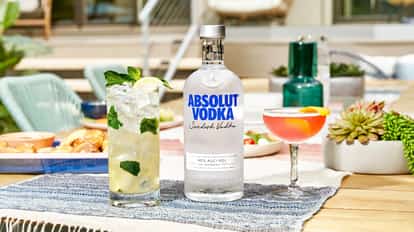
When you look at an Absolut Vodka bottle, you’ll notice a percentage on the label – this is the Alcohol by Volume (ABV), representing the amount of pure alcohol in the spirit. You might also see the word “proof,” which is another measure of alcohol, using a different scale.
Understanding alcohol content in vodka doesn’t just give you knowledge; it also helps you make informed choices, manage your intake, and drink responsibly.
In this guide, we’ll give you the tools you need to understand vodka alcohol content, so you can make your next cocktail with confidence.
Jump to:
- Decoding Vodka: Why Alcohol Content Matters
- Proof And ABV: The Language of Alcohol Content
- The Standard: 80 Proof Vodka and Its Significance
- Finding The Alcohol Content for Different Vodkas
- Exploring Vodkas with Varying Alcohol Content: Beyond the Standard Segue
- Drinking Vodka with Awareness and Moderation
Decoding Vodka: Why Alcohol Content Matters
Vodka’s smooth, clean taste and neutral flavor make it an ideal base for a wide variety of cocktails. Beyond ingredients, the alcohol content can influence how vodka tastes and feels. And that’s just the tip of the iceberg.
Here are some reasons why the alcohol content in vodka matters:
Responsible Consumption and Pacing
Knowing the alcohol percentage in vodka can help you make conscious decisions about how to drink responsibly and stay within your limits. For instance, if you’re adding vodka with an ABV of 40% to your drink, you may want to pace yourself and alternate with water and lower alcohol drinks to avoid overconsumption.
Mastering Cocktail Creation
The alcohol by volume of vodka directly impacts the potency and flavor profile of cocktails. Different vodka strengths can be used to achieve specific profiles in mixed drinks. For example, like our 40% Absolut Citron in a Cosmopolitan, or our 38% Absolut Peppar in a Sherbet Martini.
Your ABV preference can result in choosing a vodka that ranges from smooth and subtle to bold and intense.
Making Informed Purchase Decisions
Understanding alcohol content in vodka allows you to compare different brands and types of vodka based on your desired strength and overall experience. If you’re choosing between a spirit with 38% ABV or one with 50% ABV, you can confidently select one based on the occasion and your personal limits.
Navigating Legal and Social Considerations
Alcohol content is crucial for responsible drinking. It’s important to be aware of legal regulations related to alcohol content in vodka. This can help avoid excessive drinking.
Proof and ABV: The Language of Alcohol Content
Now that you know the importance of understanding vodka alcohol content, let’s explore a little further.
What is “Proof”? A Historical Perspective
“Proof” is the measurement of alcohol in a distilled spirit, which is simply double the ABV. So, if the ABV of vodka is 40%, its proof would be 80. The term “proof” dates back to 16th century England, when the government would tax spirits based on their strength.
It’s believed they would soak gunpowder in the spirit and attempt to light it on fire. If the wet gunpowder lit, the alcohol was strong enough and deemed a proof spirit. This allowed them to distinguish between drinks of different potencies, and tax spirits with a proof of 100 and above.
What is ABV? The Scientific Standard
ABV stands for Alcohol by Volume – a percentage that indicates the amount of pure alcohol in a beverage. It essentially measures the volume of the ethanol if it is separated from the rest of the solution. For example, a 750ml bottle of vodka with 40% ABV would contain 300ml of pure alcohol, and the remaining 60% would be water and other ingredients.
ABV is a more precise and scientifically accurate measure than proof and is legally required on labels of alcoholic beverages. In the UK for example, you can determine how many units of alcohol is in a drink by multiplying the size of the serving (in ml) by its ABV, then dividing it by 1,000.
The Interplay Between Proof and ABV
Proof and ABV are two different measurements that express a drink’s alcoholic strength. But they work well together too, with proof being double the ABV in the United States. While proof is more common in the United States, ABV is the standard measurement in across the globe.
However, proof and ABV calculations are different in each country. For instance, the proof is equal to ABV in France. Remember, a lower ABV of vodka doesn’t necessarily mean a weaker drink, as other factors like measurements and mixing ingredients also play a role.
The Standard: 80 Proof Vodka and its Significance
Vodka must be at least 80 proof (40% ABV) to be sold in the United States. Why? Well, it all comes down to regulatory standards.
Having a consistent scale ensures that consumers across different regions can compare the alcoholic strength of various spirits. Without this standardization, evaluating relative alcohol content in vodka would be unreliable and subjective.
This level of vodka alcohol content also allows producers to dilute their spirits with water while balancing strength, smoothness, and versatility. It’s strong enough to deliver the expected flavor without overwhelming the palate.
While 80 proof is the most common alcohol content in vodka worldwide, some vodkas may deviate slightly from the 80-proof standard. In the UK, for example, the minimum alcohol content for vodka is 37.5% ABV.
Finding the Alcohol Content for Different Vodkas
Wondering how to find the alcohol content of vodka? Next time you pick up a bottle, make sure to check the following:
- The label – This is your primary source for all things alcohol content. The ABV and/or proof should be prominently displayed on the bottle label. You’ll often find it near the brand name or bottle size at the front. Sometimes the ABV is expressed as “alc/vol”.
- The fine print – Not all labels are straightforward, and some require you to take more time over the information. Always carefully examine the label, as the details might sometimes be in small print or located in a less obvious area.
- International variations – The placement and format of the information may vary depending on the country. In the United States, the brand name and alcohol content must be in the same field of vision, whether it’s on the front, back, or side of the bottle.
Exploring Vodkas with Varying Alcohol Content: Beyond the Standard
As we mentioned, vodka is incredibly versatile, blending seamlessly with other ingredients in cocktails without overpowering them. And that’s mostly down to the vodka alcohol content.
ABV levels affect the chemical composition of cocktails differently, potentially altering the balance of flavors when mixed with other ingredients. The ABV of vodka can be the difference between a bold, intense cocktail and a mild, nuanced one. This allows bartenders to achieve specific flavor profiles.
Higher ABV vodkas may also have a different mouthfeel and can impact how other flavors in a cocktail are perceived. This is where “overproof” vodka may (literally) come into the mix. This is vodka with a higher-than-standard alcohol content, with an ABV of over 50% (or 100 proof).
So, a drink or cocktail with 100 proof vodka will taste significantly different from one made with an 80-proof vodka. But higher proof vodka doesn’t mean higher quality – just a stronger drink.
While some vodkas are marketed as having different alcohol levels, it’s important to consume them responsibly. Again, always carefully check the label to know the exact alcohol percentage in vodka before consuming.
Absolut Vodka Alcohol Content
You might now be wondering what the alcohol content is in Absolut Vodka. The short answer? Absolut Vodka Original is 40% ABV and 80 proof, which is always stated on our iconic bottles.
However, our Absolut Vodka flavors and special editions have different alcohol percentages. Som, but not all, of our flavored vodkas have a slightly lower percentage (around 38% ABV). For example, Absolut Passionfruit and Absolut Raspberri are both 38% ABV, while Absolut Grapefruit and Absolut Citron are both 40% ABV. We also offer Absolut 100 – ideal for the sophisticated Negroni or classic Mule.
You can see our full list of Absolut Vodka flavors here.
Absolut Vodka is a globally recognized brand, voted the number one spirit brand in Time’s World’s Best Brands of 2024. It isn’t just our high-quality ingredients, distinct flavors, and bottle design that wins us awards, but also our commitment to innovation. Our core offerings have consistent alcohol content, so you know you’re getting quality in every sip.
Drinking Vodka with Awareness and Moderation
Vodka alcohol content is a crucial measure that promotes moderation and awareness.
All Absolut Vodka bottles always clearly display the percentages. This allows you to easily determine which vodka suits you best, helping you make informed choices and enjoy responsibly.
Understanding alcohol content in vodka can allow you to track consumption and interpret varying drink potencies – encouraging responsible mixing or knowing when to call it a night.
Whether you’re purchasing vodka, ordering a drink in a bar, or making cocktails at home, knowing the ABV of vodka and all its variations is your first and last step to responsible drinking.
VODKA AND NUTRITION

Does Vodka Have Carbs? The Complete Guide to Vodka and Your Diet
Nov 23, 2025
Read more
Does Vodka Have Sugar? Understanding Vodka's Sugar Content
Nov 23, 2025
Read more
Is Vodka Gluten Free?
Nov 23, 2025
Read more